- The United Kingdom parliament voted on a plan that allows British researchers to change the unhealthy mitochondria cell of mother's egg to a healthy one so that the newborn will be mitochondria disease free.
- The vote results were 382 to 128
- Some scientists argue ethical issues and questions about safety
The UK parliament approved a controversial science advancement. The three-parent mitochondria gene therapy will assure that a newborn will be born without mitochondria disease. The three-parent term is used, because the scientists will need a woman and a man's cell. Then they need another woman's cell that does not have a faulty mitochondria. This way the baby will be free from the disease and still genetically related to the parents as the nucleus of the cell remains intact.
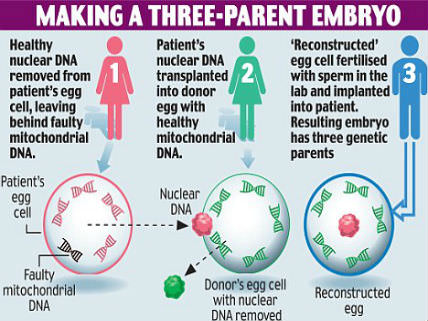
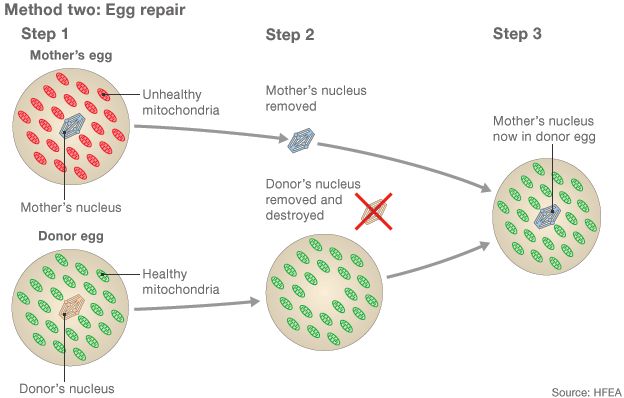
There are safety concerns raised over the topic. The government is agreeing on a very controversial topic. There are questions of ethical issues. There are questions over safety issues. There are also questions about possible new diseases and problems that the newborn baby might encounter, because of the gene change.
The three source I analyzed were AAAS, BBC, and theGuardian. Out of the three sources, BBC was the best source, while AAAS was the worst out of the three. All of the sources had the same phrasing of words and story.
 The article by AAAS has a picture of mitochondria before the
text. The headline of the article is not as detailed, unless the reader knows
what the term, three-parent mitochondrial gene therapy, in the headline
means. The article does not contain any
more visual aid. The first paragraph after the headline explains what exactly
the United Kingdom’s House of Commons voted in. It explains in short how
exactly the genetic exchange works. The article then expresses the mixed
viewpoints from two scientific experts. One of them was against it, saying that
it was a mistake. The other was delighted saying it is a scientific
breakthrough. The article then explains more about the genetic exchange.
Finally, the article talks about how the ethical and scientific reviews
supports this practice.
The article by AAAS has a picture of mitochondria before the
text. The headline of the article is not as detailed, unless the reader knows
what the term, three-parent mitochondrial gene therapy, in the headline
means. The article does not contain any
more visual aid. The first paragraph after the headline explains what exactly
the United Kingdom’s House of Commons voted in. It explains in short how
exactly the genetic exchange works. The article then expresses the mixed
viewpoints from two scientific experts. One of them was against it, saying that
it was a mistake. The other was delighted saying it is a scientific
breakthrough. The article then explains more about the genetic exchange.
Finally, the article talks about how the ethical and scientific reviews
supports this practice.
The article was really boring to read. If one was scanning
the article, he would not be able to gather key points. It does a good job of
linking some information. Overall, the article explains the news properly in
detail.
 The article by BBC includes a very blunt and non-explanatory
headline. The headline says MPs says yes
to three-person babies. The headline is targeted for British audience,
because not everyone knows what MP is. The headline kind of explains what the
process is essentially doing, creating babies through the help of three people.
The article starts with a video of Public Health minister outlining and
supporting the practice. The article is organized. The first part explains what
the voting processes a little bit and happy reaction of people who were
affected by the mitochondria disease. Then the article includes two pictures,
which help the reader to understand exactly how the process works. At the end
of the article, it talks about the safety concerns of the practice.
The article by BBC includes a very blunt and non-explanatory
headline. The headline says MPs says yes
to three-person babies. The headline is targeted for British audience,
because not everyone knows what MP is. The headline kind of explains what the
process is essentially doing, creating babies through the help of three people.
The article starts with a video of Public Health minister outlining and
supporting the practice. The article is organized. The first part explains what
the voting processes a little bit and happy reaction of people who were
affected by the mitochondria disease. Then the article includes two pictures,
which help the reader to understand exactly how the process works. At the end
of the article, it talks about the safety concerns of the practice.
This article does a really good job of covering the story.
It talks about the voting process, the scientific process, and the safety
concerns. The visual aid helps someone who does not know about the topic to
understand exactly how the mitochondria exchange process will work. Therefore
this article does the best job in covering the story
 The article by The Guardian starts with a non-explanatory
headline. Then there is a video that shows a person announcing the voting
results. This article then starts talking about the voting process. The voting
process is explained in detail. Then the article brings in the opinion of
people. The article seems to be little biased as it touches on the positive of
the mitochondria exchange. The article then talks very little about the process
of the mitochondria exchange. Then it talks about the statistics of mitochondria
disease. Then the article goes on to support the mitochondria exchange.
The article by The Guardian starts with a non-explanatory
headline. Then there is a video that shows a person announcing the voting
results. This article then starts talking about the voting process. The voting
process is explained in detail. Then the article brings in the opinion of
people. The article seems to be little biased as it touches on the positive of
the mitochondria exchange. The article then talks very little about the process
of the mitochondria exchange. Then it talks about the statistics of mitochondria
disease. Then the article goes on to support the mitochondria exchange.
This article was biased. The article was informative in
explaining about the voting process. However, it talks little about the
concerns over the process. The article barely includes any text that explains
the possible negative effects. Unlike the other two articles, this article does
not talk about the safety concern. This article does the worst job in covering
all parts of the story.
Things the article should do better on:
- More explanatory headline
- Include more visual aid
- Emphasize on the important points through bold letters, or bullet points
- Include links to information about the project
- Talk more about the mitochondria exchange process
- Give more insight on the safety concerns over the process.


